
Tile Roof Repair Port Charlotte FL — Expert Tile Matching
Concrete barrel and flat tile roofs are engineered to withstand Southwest Florida hurricane winds. However, when storm gusts shift tiles or aging underlayment beneath degrades, water intrusion follows. We specialize in sectional tile lift-and-lays, exact profile matching, and heavy-duty underlayment replacement.
About Our Professional Tile Roof Repair Services in Port Charlotte FL
Tile roofs in Port Charlotte are known for their durability and classic aesthetic, but when leaks occur, the repair process requires specialized trade knowledge. A broken tile is often a symptom of underlying felt membrane breakdown rather than the primary cause of water entry.
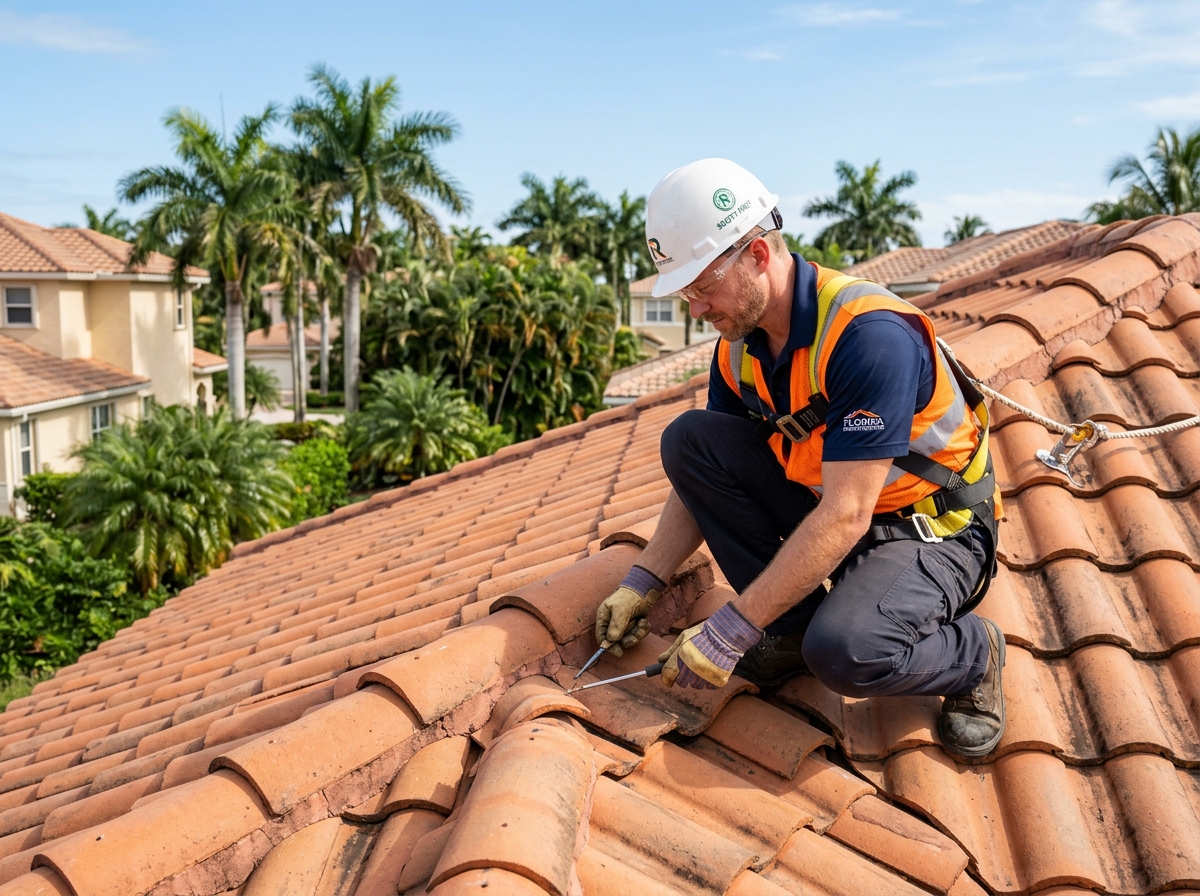
Our licensed Port Charlotte tile roof repair team provides surgical sectional tile lift-and-lay repairs. As top-rated professional roofing specialists in Charlotte County, we carefully remove sound tiles, inspect the timber decking, install heavy-duty self-adhering underlayments, and re-set tiles using Florida-code-compliant mortar pointing.
Indications Your Tile Roof May Need Professional Evaluation
Tile roof deterioration is often hidden beneath the outer shell. Here is what homeowners can observe safely from the ground and interior spaces.
What Homeowners Can Safely Observe
You do not need to walk on fragile tiles to detect early signs of tile roof breakdown. Look for these visual indicators around your property:
- Cracked or Slipped Tiles: Visible gaps along roof slopes, eaves, or ridge caps where tiles have shifted out of alignment.
- Deteriorated Hip & Ridge Mortar: Crumbling, sandy mortar debris washing down into gutters or lying in flowerbeds after rainstorms.
- Ceiling Water Rings & Damp Attic Insulation: Circular yellow/brown water stains on ceiling drywall, especially following heavy tropical rain.
- Exposed Underlayment Felt: Dark, torn underlayment showing between broken or missing tile courses.
The Underlayment Beneath Your Tiles Is the Actual Waterproofing Layer
A common misconception among homeowners is that concrete or clay tiles provide the waterproof seal. In reality, **tiles act primarily as a primary watershed and UV sunshield**.
The **true waterproof barrier is the asphaltic underlayment membrane** installed directly over the plywood deck. Over 15 to 20 years in Southwest Florida, intense heat causes organic felt underlayments to dry out, crack, and tear. Water penetrating tile joints reaches the brittle underlayment and leaks into the attic framing.
Common Tile Roofing Problems in Port Charlotte
Southwest Florida's coastal climate accelerates tile roof component breakdown in distinct ways.
UV & Heat Underlayment Breakdown
Extreme attic temperatures reaching 140°F dry out standard 30lb felt underlayment, making it brittle and vulnerable to moisture seepage.
Spanish Barrel Tile Mortar Bed Failure
Salt-air humidity and thermal expansion cause hip and ridge mortar beds to crack, allowing driving rain under peak tiles.
Rusted Metal Valley Flashing Seams
Coastal Charlotte Harbor moisture corrodes galvanized metal valleys hidden under woven valley tiles, causing hidden deck rot.
High-Wind Hurricane Tile Lift
Hurricane wind gusts lift unsecured tile courses along eaves and gables, snapping fastening nails and exposing underlayment seams.
Cracked Pipe Boot Neoprene Collars
UV radiation degrades rubber vent pipe boots protruding through tile roofs, creating direct water paths down vent stacks.
Rotten Wood Tile Battens
Trapped moisture beneath slipped tiles rots horizontal 1x2 pine batten strips, causing surrounding tile courses to sag.
Our Comprehensive Port Charlotte Tile Roof Repair Solutions
Sectional tile repair solutions designed for long-term weather protection.
Broken & Cracked Tile Replacement
Sourcing exact profile, color, and manufacturer concrete barrel or flat tiles to replace damaged sections seamlessly.
Sectional Underlayment Replacement
Lifting tile courses around leak areas and installing self-adhering modified bitumen Dual-Ply SWR underlayment membrane.
Spanish Barrel Tile Re-Mortaring
Removing deteriorated mortar at hip, ridge, and eave closures and re-pointing with oxide-tinted, polymer-modified roofing mortar.
Valley Metal Flashing Weaving
Replacing rusted valley metal with heavy-gauge aluminum or copper valley flashing, re-weaving surrounding valley tiles.
Rotten Subfloor Decking Repair
Replacing water-damaged plywood OSB sheathing underneath failed tile sections and reinforcing rafter timber.
Step Flashing Tile Interlocking
Re-building aluminum step flashing wall transitions along dormers and two-story wall intersections beneath tile lines.
High-Wind Ridge Tile Anchoring
Installing stainless steel tile clips and hurricane-rated adhesive foam to secure ridge and eave tiles against uplift.
Skylight & Vent Flashing Sealing
Replacing lead pipe boot aprons and custom metal skylight flashing pans woven into surrounding tile courses.
Preventative Tile Maintenance
Applying elastomeric sealants, clearing debris from tile valley channels, and securing loose tiles before storm season.
How Tile Roof Repairs Are Completed
A step-by-step technical breakdown of our sectional tile lift-and-lay repair process.
Identify Damaged and Displaced Tiles
We walk the roof surface carefully to locate cracked, broken, shifted, and missing tiles. The inspection also covers hip and ridge mortar, transition areas, and any sections where the underlayment may be exposed.
Evaluate the Underlayment and Batten Condition
Beneath each damaged tile, we check the underlayment for tears, UV degradation, and moisture evidence. The battens — the horizontal strips that tiles rest on — are checked for wood rot or loosening that could affect tile stability.
Replace Damaged Components
Cracked tiles are replaced with matching profiles. Failed mortar at hip and ridge lines is removed and reapplied. If the underlayment has deteriorated in the repair area, it's addressed before new tiles are set.
Verify Tile Placement and Water Path
After the repair, we confirm that all replaced tiles are properly seated, that the water drainage path across the repaired section is unobstructed, and that surrounding tiles haven't been disturbed during the work.
Port Charlotte Tile Roof Repair Case Studies
Real-world examples of sectional tile restoration and underlayment repair in Charlotte County.
Spanish Barrel Tile Underlayment Replacement
Problem: Homeowner noticed ceiling water stain in dining room after summer downpours. Previous inspector recommended $32,000 complete tile re-roof.
Solution: Our crew lifted 120 sq. ft. of Spanish barrel tiles surrounding leak zone. Replaced brittle 18-year-old felt with dual-ply self-adhering membrane, installed new battens, and re-set original tiles with fresh mortar.
Result: Leak resolved at 80% lower cost than full replacement, preserving original tile roof aesthetics.
Waterfront Canal Home Rusted Valley Flashing
Problem: Salt-air corrosion rusted out galvanized valley metal underneath woven tile valley, causing rot in 16 sq. ft. of plywood decking.
Solution: Removed valley tiles, replaced damaged CDX plywood decking, laid ice & water shield membrane, and installed heavy aluminum valley flashing before re-weaving tiles.
Result: Restored structural deck integrity with a 10-year waterproof warranty.
Common Questions
Answers to common questions about tile roof repairs, underlayment lifespans, and tile color matching in Port Charlotte.
How long does a tile roof underlayment last in Port Charlotte?
Standard 30lb organic felt underlayment lasts 15 to 20 years in Florida's climate. Modern self-adhering modified bitumen membranes (SWR) can last 25 to 30 years before requiring sectional or full underlayment replacement.
Can cracked roof tiles be repaired or do they need replacement?
Hairline tile cracks can occasionally be sealed with elastomeric roofing compound, but cracked or broken tiles exposed to heavy rain should be replaced with matching concrete or clay tiles to maintain structural integrity.
Why is my ceiling leaking if none of my roof tiles are broken?
Tiles act as a primary watershed, but the underlayment underneath is the true waterproof barrier. Water can seep through aged felt tears, deteriorated valley metal, or cracked pipe boots without breaking a single tile.
Can I safely walk on my concrete tile roof?
No. Walking on concrete or clay tiles without proper weight distribution techniques can easily snap tiles and tear underlying felt. Our technicians use soft-padded ladders and rafter weight distribution boards.
Related Roofing Services in Port Charlotte
Tile roof repairs often involve components that have their own dedicated repair approach. Explore related services for more information.
Roof Leak Repair
Precision attic leak tracing, thermal moisture imaging, and surgical sectional fixes. View Details →
Emergency Roof Repair
24/7 rapid response active leak tarping and emergency storm damage containment. View Details →
Storm Damage Repair
Hurricane wind-lift restoration, shingle tab replacement, and insurance claim repairs. View Details →
Shingle Roof Repair
Architectural asphalt shingle tab repairs, high-wind uplift fixes, and nail pop sealing. View Details →
Roof Flashing Repair
Rusted metal valley replacement, step flashing rebuilding, and wall apron sealing. View Details →
Roof Deck Water Damage
Replacing water-soaked plywood OSB deck sheathing and reinforcing rafter timber. View Details →
Serving All 7 Port Charlotte ZIP Codes for Tile Roof Repair
We dispatch tile roofing repair technicians daily across all Port Charlotte neighborhoods as well as Punta Gorda roof repair projects, North Port FL, and Englewood FL.
Have a Leaking Tile Roof in Port Charlotte?
Do not let a broken tile or cracked underlayment ruin your ceiling drywall. Call our local tile roof repair specialists for an on-site walkthrough and written estimate.

Ready for Expert Tile Roof Repair in Port Charlotte?
Get your tile roof inspected by licensed local technicians. We provide exact tile matching, dual-ply SWR underlayment replacement, and 10-year waterproof warranties.